Hebden Bridge Flood Alleviation Scheme

Our Flood Information Centre on Valley Road is open every Thursday from 10am to 2pm. Drop in for project updates and to meet the project team. For further details, explore the scheme below or contact [email protected].

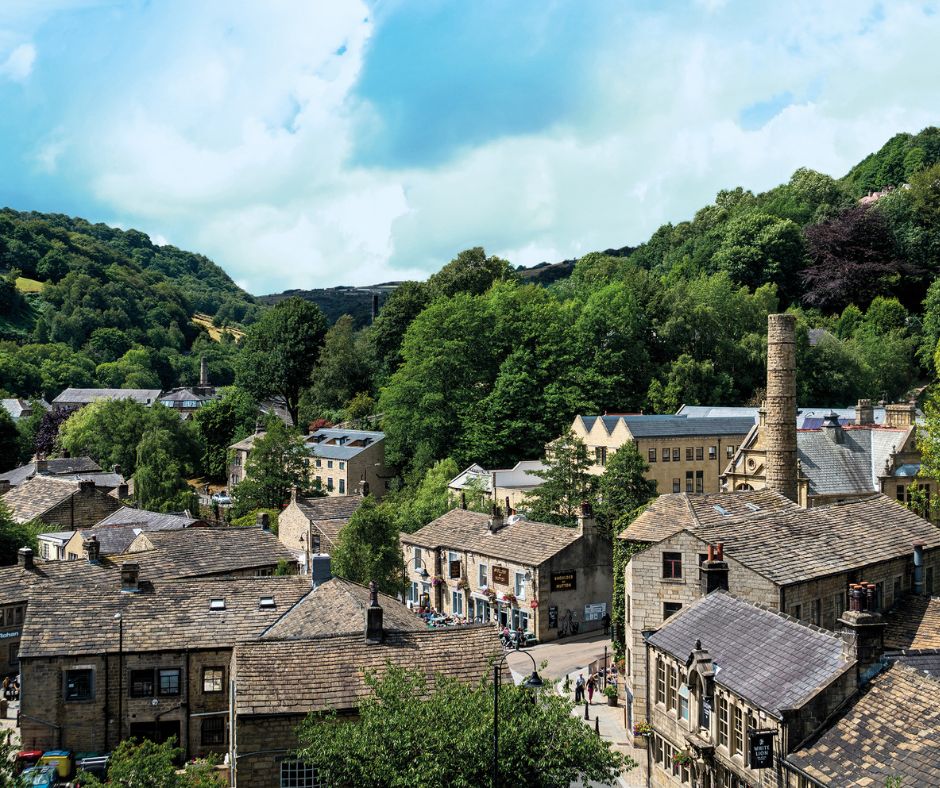
An elevated view of a historic village nestled in a valley, featuring traditional stone buildings with grey slate roofs. A tall, stone industrial chimney stands among the houses and lush green trees. In the background, steep, wooded hills rise toward a bright sky with scattered white clouds.
Hebden Bridge Flood Alleviation Scheme

The Environment Agency is building new flood defenses in Hebden Bridge. The goal is to protect local homes and businesses. This project will safely lower the risk of floods and help the town stay secure for the future.

About the scheme

Hebden Bridge faces flood risks from rivers, the Rochdale Canal, and surface water. Located in a steep-sided valley, the town marks the confluence of three key watercourses:

  • The River Calder
  • Hebden Water
  • Colden Clough
The scheme includes:
    • Raising and strengthening river walls. 
    • Construction of new walls within St Pols Car Park.
    • Construction of vertical rising flood barriers on Bridge Gate and Old Gate.
    • The repair and reinforcement of specific properties.
    • Modification to five weirs.
    • The replacement of Central Street Footbridge.
    • Reinforcement of two bridges across Hebden Water.
    • Landscaped public open spaces.

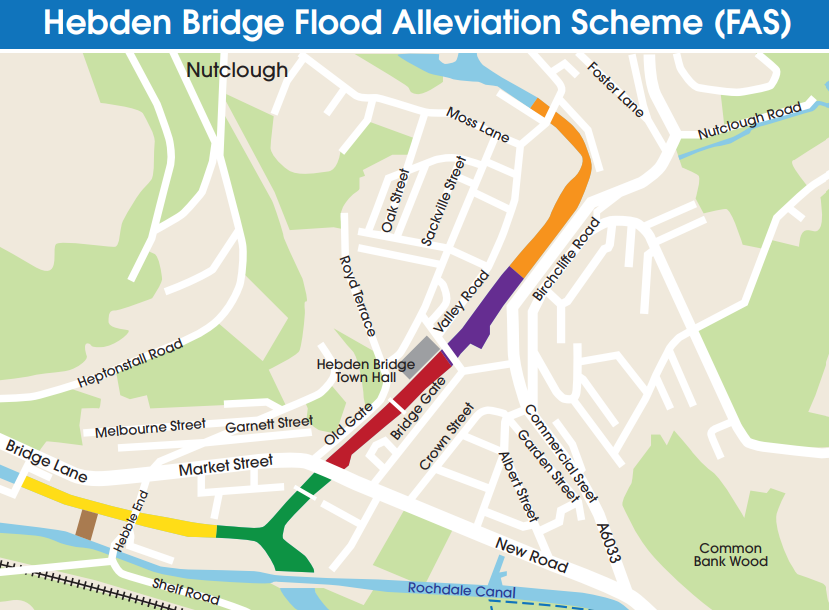
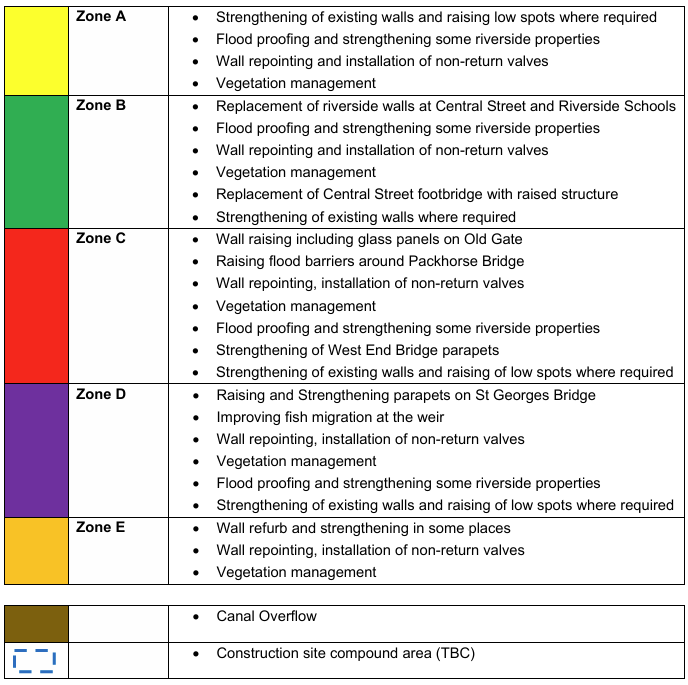
Map key - view information about each zone.

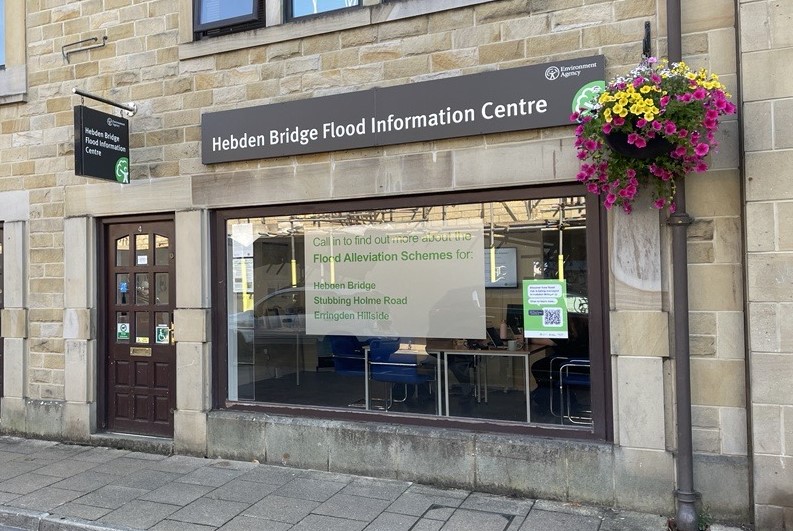
The front of the building for the Hebden Bridge Information Centre
Latest information


Drop-in Events - February and March 25

Thank you to everyone who came along to the drop-in events on 27th February and 6th March.

Frequently Asked Questions

Why is the scheme is required, and what it will change?

Also covered:

What will the scheme do to help with flooding?

What is the current flood risk at the wavy steps?

How many properties will benefit from the scheme?

Answer

Hebden Bridge has a long history of frequent and severe flooding. This scheme will provide an increased level of protection from river flooding. Whilst no flood alleviation scheme can completely remove the risk of flooding, it will reduce the frequency and provide increased protection to the local community, infrastructure and environment. The first point that the Hebden Water River floods is at the wavy steps; there is currently approximately a 20% chance of this happening in any given year.

Once the scheme is built, Hebden Water will have to get to about 1.4m higher than the top of the wavy steps for a flood event to occur; there will be about a 2% chance of this happening in any given year. As a result of the scheme, approximately 400 properties will be better protected from flooding across the Hebden area.

Will floods still happen after the scheme is built?

Also covered:

How much will the flood risk be reduced by the scheme?

Can the scheme protect against extreme flood events like Boxing Day 2015?

Are there any other projects supporting flood risk reduction?

Answer

Yes, the scheme is designed to significantly reduce the risk of fluvial (river) flooding in the area, but no flood alleviation scheme can provide absolute protection against all flooding.

There is currently a 20% chance of flooding occurring in Hebden Bridge in any given year. This flood alleviation scheme will reduce that risk down to 2% in any given year. Significant events, such as Boxing Day 2015, would still pose a risk to Hebden Bridge, as it is not practical to design wall heights for such rare events. However, in such incidents the scheme will give residents and businesses more time to prepare for the onset of flooding, implement flood plans and deploy any property flood resilience measures they may have. It is important to consider these defences as one part of the bigger picture. In addition to this flood alleviation scheme, Natural Flood Management measures on the hillsides and upstream of Hebden Bridge in areas such as Erringden Hillside and Hardcastle Craggs have been implemented to help slow the flow of water.

A project is currently being developed between the Environment Agency and Yorkshire Water to evidence the benefit of utilising the Hebden reservoirs for flood water storage. All of these measures working together will significantly reduce the risk of flooding in Hebden Bridge even further. The scheme will not reduce risk of surface water flooding – it will remain the same as present day.

Apart from flood risk reduction, what are the benefits of the scheme?

Also covered:

How will the scheme support the town’s economic future and investment potential?

How does the scheme contribute to biodiversity and environmental sustainability?

What are the wider benefits for businesses, commuters, tourists, and emergency services?

Answer

The scheme will:

  • Improve economic viability for the town and potential future investment.
  • Maintain or enhance riverside areas, with pocket parks, sympathetic design and sightlines to the river maintained where possible.
  • Deliver 10% Biodiversity Net Gain through a series of aquatic and terrestrial measures including nature bricks, vertipools and tree planting.
  • The scheme will deliver environmental improvements, such as the modification of 5 weirs on the River Calder and Hebden to improve fish passage and associated environmental benefits in the Upper Calder catchment.
  • Directly protect two schools, thereby reducing the risk of lost educational days.
  • Reduce the risk to the A646, an arterial route linking Halifax and Rochdale across the Pennines, and the A6033 Keighley Road. This will improve access for businesses, residents, commuters, tourists and emergency services up and down the valley and reduce the risk of damages from future flood incidents.

Why is the scheme taking so long?

Also covered:

Why does a flood alleviation scheme take time to implement?

Why is the Hebden Bridge scheme particularly complex?

How do steep valleys and rapid river level changes impact the design process?

Answer

To bring any flood alleviation scheme to fruition there must be planning, surveying, consultation and design before any physical work can begin. The design must take account of a large range of factors including: the requirements of stakeholders; what is technically possible; heritage concerns; environmental impacts; what is financially and economically viable; construction and operation health and safety; and many more. The scheme for Hebden Bridge is not the largest scheme the Environment Agency is undertaking; however, it is one of the most complex. This complexity comes from:

  • The density of infrastructure already in the valley
  • The number of buildings adjacent to the river
  • The steep valleys and speed at which the river level rises
  • The number of listed and historic buildings
  • Conflicting significant heritage and environmental concerns
  • The amount of buried services within a constrained area

This complexity has meant that it has taken longer than most flood alleviation schemes to develop a viable design that can be taken forward to planning and construction.

How certain is the scheme to go ahead?

Also covered:

Is the scheme technically viable?

Does the scheme currently deliver enough benefit to proceed?

When will the planning application be submitted?

Answer

We know the scheme is viable from a technical perspective, and at this stage, delivers sufficient benefit; however, we are still finalising costs, seeking planning permission and securing funding. We are seeking all necessary approvals now, such that when funding is available, the scheme can be constructed at pace.

The planning application is expected to be submitted to Calderdale Council mid-2025.

What other options have been considered for the scheme?

Also covered:

What types of options have been considered to reduce flood risk in Hebden Bridge?

Was floodwater storage considered as a solution for Hebden Bridge?

How are different flood management strategies being combined in the scheme?

Answer

Many different options have been considered for reducing flood risk in Hebden Bridge. These can be broadly separated into three categories – storage, conveyance and containment. Modelling, consultation and optioneering has been undertaken to identify the most effective and cost beneficial options to better protect Hebden Bridge from flooding.

Storage:
Other than the existing water supply reservoirs, the storage volume available in this steep sided catchment compared to the volume of flood water, leads to limited benefits as only part of the flood volume could potentially be stored, with the remainder still reaching the town.

Conveyance:
Significant reprofiling of the channel such as removing weirs and channel constrictions has only limited beneficial effects on flooding within Hebden Bridge. The weir modifications planned are to contribute towards mitigating the environmental impacts of the scheme. Modifying or removing some bridge structures could have a significant benefit on reducing flooding. However, it would not be feasible to completely remove the bridges which would reduce access through the town. In addition, they are protected for their heritage value and within a conservation area, so any modification would be difficult and costly. This option would also have to be combined with containment interventions, making it non-cost beneficial.

Containment:
Strengthening and raising existing river walls and constructing new flood defences. This category of options successfully contains the flow within the channel, protecting the surrounding area. However, limitations prevent the wall being extended beyond a height which would restrict views of the surrounding area or increase flood risk elsewhere therefore limiting the degree that flood risk from rivers can be reduced. It is important to consider these defences in combination with the other measures being delivered and explored in the catchment including Natural Flood Management and the potential for storage in the water supply reservoirs.

Documents 1-22 in the Working with the Community section on the Eye on Calderdale website - Hebden Bridge Flood Alleviation Scheme - Eye on Calderdale provide further detail on the different options to reduce flood risk in Hebden Bridge and how these have been investigated and considered. These documents were shared at the public consultation in 2017.

Why can’t you do individual property protection instead?

Also covered:

Why is a large-scale flood alleviation scheme necessary in the Upper Calder Valley?

What critical infrastructure will the scheme help protect?

What are the limitations of Property Flood Resilience (PFR) measures?

Answer

The Upper Calder Valley is a steep sided, flashy catchment and the risk of rapid onset of flooding can represent a danger to life. As well as protecting approximately 400 properties, the proposed flood alleviation scheme will better protect:

  • Access into and through the town for emergency services
  • Two schools on the confluence of Hebden Water and River Calder
  • Personal and business vehicles
  • Local heritage features, listed structures and amenities in the town
  • Local utility infrastructure
  • Local transport infrastructure

Whilst Property Flood Resilience (PFR) can be an effective measure for reducing flood risk to individual properties, there are limitations to the depths which external measures can effectively resist flood water. Government guidelines suggest 600mm (2ft) as a safe height to resist water entry. Flood protection in excess of 600mm in height should only be installed subject to a structural survey being undertaken on the property.

When will construction work start?

Also covered:

What needs to happen before construction can start?

When will the scheme be completed?

Will the scheme be phased?

Answer

The team are working hard to start work on the ground in mid-2026, and we will continue to improve certainty of this date as we move forward with all necessary approvals. There are a number of milestones to achieve before construction can start, including:

  • Securing planning permission
  • Agreeing a cost beneficial and affordable construction price
  • Securing full funding
  • Securing Full Business Case approval
  • Appointing a construction contractor
  • Securing listed building consents and environmental permits.

The total anticipated construction period is four years, so based on construction commencing in mid-2026, forecast completion would be late 2030.

The construction areas will be delivered in pockets of work, phased across a four-year period to reduce the impacts on the community. A construction programme will be shared with the community ahead of work commencement detailing the construction areas and timescales.

What is being done about surface water risk?

Also covered:

Will the scheme address surface water flood risk as well as river flooding?

What is being considered to reduce surface water flood risk?

What is Property Flood Resilience (PFR)?

Answer

Alongside delivery of the fluvial scheme, project partners will be exploring potential opportunities, such as Property Flood Resilience to reduce surface water flood risk to those residential and commercial properties directly affected. Property Flood Resilience are measures which can help prevent water from entering a property, commonly referred to as resistance measures and may include flood barriers, air brick covers and other external measures.

Can anything be done to reduce surface water flooding on Market Street?

Also covered:

What is being done to reduce surface water flooding in Hebden Bridge?

What Natural Flood Management (NFM) measures are being used on Erringden Hillside?

Which areas are targeted for drainage improvements?

Answer

As part of the Erringden Hillside Flood Alleviation Scheme, improvements to highway drainage and surface water capture are being delivered in partnership between the Environment Agency and Calderdale Council for New Road, Hebble End and Shelf Road to reduce the surface water runoff that crosses Hebble End Bridge and contributes to surface water flooding on Market Street. In addition, through the Calderdale Landowner Grant Scheme, Natural Flood Management measures including attenuation ponds and cross contour hedging are being delivered on Erringden Hillside to slow the flow of surface water down to the town.

Why was the surface water scope descoped?

Also covered:

What legal requirement affects storm overflow discharges?

Will a separate project be needed to meet this requirement in Hebden Bridge?

Who is involved in making this decision?

Answer

In the Environment Act 2021, the government placed a legally binding duty on water companies to progressively reduce the adverse impacts of discharges from storm overflows. It is anticipated that to deliver this requirement in Hebden Bridge, a future large project requiring significant new physical infrastructure will be needed. It is now understood between Yorkshire Water, Calderdale Council and the Environment Agency that the infrastructure necessary to reduce the number of discharges from storm overflows (i.e. to comply with the Environment Act 2021) cannot be accommodated once the surface water scheme infrastructure currently designed for the project is installed. Simply, the two schemes demand the same physical space, and are therefore in conflict. To ensure the most significant source of flooding facing the town is addressed as soon as possible, the Hebden Bridge FAS Project Board have confirmed that the fluvial scheme to better protect the community from flooding from the River Calder and Hebden Water will continue to progress now.

The walls seem to be quite high in places – how have you determined the required height of the walls?

Also covered:

Why are the flood walls being built to a specific height?

How was the wall height determined?

Why can’t the walls be made lower?

Answer

The purpose of the scheme is to retain the water in the river at higher levels and reduce flood risk to the town. Therefore, once the scheme is in place, during a high flow event, river levels in channel will reach a higher level than they currently do because water that currently floods and spreads out across town will be constrained within the river channel. The wall heights have been set to provide a significant increase in flood protection to the town without increasing flood risk elsewhere. This height has been set in consultation with stakeholders to strike a balance between level of protection and visual impact.

To be progressed, the scheme must demonstrate that the economic benefit provided is greater than the cost. If the walls were made lower, the scheme would not be economically beneficial as the benefits would decrease substantially more than the costs.

Why are you having to work on St George’s bridge and what will this involve?

Also covered:

How will the scheme reduce flood risk to the town?

Why does St Georges Bridge need to be strengthened?

What happens to floodwater under the new scheme during high flow events?

Answer

The purpose of the scheme is to retain the water in the river at higher levels and reduce flood risk to the town. Therefore, once the scheme is in place, during a high flow event, river levels in channel will reach a higher level than they currently do because water that currently floods and spreads out across town will be constrained within the river channel.

There are two elements of work to St Georges Bridge:

  1. The parapet on the eastern side of the bridge needs to be raised to prevent water from flooding out at this point
  2. The bridge needs to be strengthened to enable it to withstand the increased force it will experience as a result of more water being retained within the river channel.

During construction, how much noise and disruption will my home/business experience?

Also covered:

What is being done to minimize the impact of the construction?

How will the project team support those directly affected by the construction?

Is the construction expected to cause inconvenience?

Answer

The impact will depend on how close you are to the construction activities. While we are dedicated to keeping noise and disruption to a minimum, there may be some unavoidable disturbance given the nature of a construction project of this size. We’re committed to working closely with those who are directly affected and will do everything we can to reduce inconvenience.

What will be the impact on car parking, both during and after construction?

Also covered:

Will there be any loss of public parking during construction?

Will fenced-off areas be reopened promptly once no longer needed?

What changes will be made to Old Gate after construction?

Answer

During construction, there will be temporary loss of public parking at the following sites (estimated number of spaces): St Pols (30), Calder Terrace (30), Old Gate (15) while works are undertaken in those areas. There will also be temporary loss of private parking at various sites during the construction phase. The project partners are highly aware of the pressures on parking, and therefore required areas will be fenced off only when required and reopened at the earliest opportunity.

Post construction:

  • Old Gate will become a no stopping road.
  • Approximately 7 spaces will need to be removed from St Pols carpark due to the alignment of the proposed flood defence wall.

What will be the impact on traffic during construction?

Also covered:

Will traffic management be required during the construction works?

How will the community be informed about traffic management plans and dates?

What measures are in place to manage construction-related traffic?

Answer

Traffic management will be required during works at West End Bridge and St Georges Bridge. We will work closely with the community, partners and our contractors to clearly communicate dates and ensure the traffic management operates as efficiently as possible to minimise disruption.

There will be some additional traffic in town to transport materials, plant and operatives to and from the different work areas as required. Overall traffic impact will be mitigated by:

  • Utilising a tower crane and St Pols car park as a ‘hub’ for the central works in the Bridge Gate and Old Gate area.
  • Providing operative staff parking at the main compounds to minimise the use of public parking.
  • All HGV deliveries will be directed to the main compounds.
  • Encouraging commuting via public transport to reduce the number of personal vehicles.

Why is a tower crane being proposed?

Also covered:

How will the use of a tower crane reduce disruption in the town centre?

Is the use of the tower crane guaranteed throughout the project?

What factors could change the decision to use a tower crane?

Answer

A tower crane will minimise the disruption to the heart of town, importantly in the Bridge Gate area. Construction vehicle movements in this area will be reduced and road/lane closures will be minimised by reducing the need to temporarily mobilise large cranes to site to support the works. The use of a tower crane is subject to change, depending on our construction partner’s final methodology.

How will traffic be diverted when St George’s bridge needs to be closed for work?

Also covered:

How long will the full closure of St George's Bridge last?

Will both traffic and pedestrians be affected by the closure?

Will any temporary traffic measures be introduced to support the diversion routes?

Answer

There will be periods in which St George's Bridge needs to be fully closed to all traffic and pedestrians during the works. These periods will be minimised as far as is practicable. We expect these periods to be 4-5 months in duration and to take place during the later phases of the project, in circa 2029/30.

During full closures, we expect a vehicular diversion will be in place through Valley Road Victoria Road-Windsor Road-Foster Lane-Keighley Road, with HGV/LGV’s being diverted down Old Gate and exiting via Foster Lane. We expect temporary double yellow lines will be required in certain areas to facilitate access though pinch points and formalise the existing single side parking arrangements along the diversion route. We are highly aware that roadside parking is used by the local residents here and any temporary reduction in roadside parking will be minimised as far as reasonably possible. These plans will be carefully developed and communicated to residents ahead of any work being carried out.

How much of Calder Holmes Park is being occupied, and why?

Also covered:

Why was Calder Holmes Park chosen to support construction activities in Hebden Bridge?

Will the entire Calder Holmes Park be closed during construction?

Will the café side of the park remain open during the works?

Answer

Calder Holmes Park has been identified as the only available, suitable space to support the construction activities in Hebden Bridge within walking distance of the works for the delivery team. The footprint to be occupied has been minimised by utilising a compound in Mytholmroyd for staff and non-essential site personnel. The planning application will show that the compound will be located where the football pitches are. The rest of the park, on the side of the café, will remain open.

The planning application includes Calder Holmes Park as the proposed location for a site compound, however, we want to emphasise that this is not our preferred option.

We fully recognise the importance of Calder Holmes Park to the local community and the potential impact its use could have. The surface water flood alleviation elements of the proposed scheme, which have since been descoped, required the construction of a pumping station in the south east corner of Calder Holmes Park (by Station Road car park). The construction of the pumping station would have required a construction compound at this location and the park was therefore identified as the most viable compound for the scheme and proposals developed.

As the Hebden Bridge Flood Alleviation Scheme is currently progressing as a fluvial (river) only scheme, the construction of the pumping station will not be taken forward. This therefore opens the opportunity to explore alternative locations and we are currently in discussions with landowners to identify a more suitable site.

Suitable spaces for a compound of this scale are extremely limited in Hebden Bridge due to the town’s geography and infrastructure. To avoid further delays to the planning process, we needed to submit the application with Calder Holmes Park as the identified option. This ensures the scheme can continue progressing while we pursue alternatives.

If we are successful in securing a different location, we would submit a new planning application for that site. We remain committed to working closely with the community to minimise disruption and will continue to keep you updated as discussions evolve.

What reinstatement of Calder Holmes Park is being planned?

N/A

Answer

Following completion of the works, Calder Holmes Park will be returned to its existing status.

Who will maintain the raising barriers?

N/A

Answer

The Environment Agency will be responsible for operating and maintaining the raising barriers including servicing and parts replacement as required throughout the 50-year design life of the scheme.

What assessment has been done re. impact the works will have on business footfall?

Also covered:

Has an economic assessment been carried out for the Hebden Bridge Flood Alleviation Scheme?

How does the scheme demonstrate economic benefit?

How will the scheme affect tourism in Hebden Bridge?

Answer

A full economic assessment has been undertaken that will support the economic case for the Hebden Bridge Flood Alleviation Scheme. This includes economic analysis of the damages caused by flooding to properties, people, vehicles, emergency services, local infrastructure, tourism, recreation and heritage, and calculation of damages avoided with a flood alleviation scheme in place to show the economic benefit of the proposed scheme. The planning application will also include a Full Environmental Impact Assessment and associated documents that analyse the potential social and environmental impacts during construction and how these will be minimised and managed.

We recognise that Hebden Bridge is an extremely popular tourist destination in the Calder Valley and understand the impact that our work may have on the local business that support the tourism industry, alongside the disruptive nature that our work may entail. We will work closely with local events organisers and the council to ensure, as far as possible, we minimise any disruption to any planned events for the town. Where the Environment Agency undertake works under the relevant sections of the Water Resources Act 1991, a business may be entitled to claim compensation for losses in respect of these works.

It is the responsibility of a business to put forward a claim to the Environment Agency, in which any losses which they feel have resulted from the works are substantiated. We are working closely with our contractors to identify the extent of construction areas across the scheme and understand potential methodologies and timescales in order to develop a compensation budget that will be included in the overall cost of the flood alleviation scheme.

During detailed design we have worked closely with the owners/tenants of the riverside properties that will be directly impact by the construction work on or within their ownership, sharing the designs, providing opportunity to comment, and communicating timescales. We will continue to work with them through the forthcoming planning process and into project delivery to minimise and mitigate the impacts during the works.

A Key Stakeholder Group has been established for the scheme since 2018. The group consists of partners, flood wardens, councillors and local community group representatives, including Hebden Royd Business Forum. The purpose of the group is to be the ‘eyes and ears’ of the community on our behalf, to disseminate information out to the public and seek feedback to advise the project team. This group will continue to operate regularly throughout planning and construction.

Which businesses will be most affected, and what support will they receive?

Also covered:

Have property and landowners been consulted about the project?

What is being done to minimise and mitigate the impact of works on private property and businesses?

Are affected landowners being supported throughout the project?

Answer

Over the last few years, we have been engaging directly with affected property and landowners to discuss proposals where work will be required on their property / land. We will continue to work with these businesses throughout project planning and during delivery to minimise and mitigate the impacts during works.

Can I get compensation for disruption to my business?

Also covered:

Will the flood alleviation scheme cause disruption to local businesses?

Could the construction works have financial impacts on businesses or property owners?

What should businesses/property owners do to claim compensation?

Answer

We recognise that the construction of this flood alleviation scheme may cause some temporary disruption to some businesses. We will continue to work closely with the community and our partners to minimise the disruption far as reasonably possible, however we appreciate that these works may have some financial impact on some businesses/property owners. Where the Environment Agency undertake works under the relevant sections of the Water Resources Act 1991, a business/property owner may on occasion be entitled to claim compensation for losses in respect of these Works. You should continue to operate your business/property as normal and mitigate your losses. It is the responsibility of a business/property owner to put forward a claim to the Environment Agency, in which any losses which you feel have resulted from these works are substantiated. As part of submitting such a claim, if you wish to appoint an agent to act upon your behalf, should a claim be substantiated, their reasonable fees for dealing with this matter would be met by the Environment Agency in line with our guidance on payment of third party fees. You will be able to start this process by contacting [email protected].

What sustainable materials are being used in the construction?

N/A

Answer

The scheme will use low-carbon and precast concrete, recycled aggregates, natural stone, and recycled steel (piles, reinforcement, structural steelwork).

What are you doing about achieving net zero carbon emissions?

Also covered:

How will the flood alleviation scheme incorporate sustainability?

Will the scheme use locally sourced or recycled materials?

How will the scheme reduce its carbon footprint during construction?

Answer

The scheme will:

  • Utilise sustainable, locally sourced, and recycled materials.
  • Adopt low carbon means of construction.
  • Use greener energy sources for compounds (solar, hydrogen)
  • Lower carbon emissions through efficient design and value engineering
  • Lower carbon emissions during construction by limiting vehicle movements, reducing dependency of diesel generators, choosing more efficient plant and equipment, encouraging commuting via public transport.

How many trees are being lost, are any A or B category?

Also covered:

What is the quality classification of the trees being removed?

Will efforts be made to retain trees during construction?

Will any trees be protected during construction?

Answer

To facilitate construction of the Scheme, 117 trees will need to be removed; 77 from the main fluvial works and an assumed total of 40 from the weir works, which we expect to reduce in detailed design.

Of these, 1 is Category A (high quality) 29 are Category B (moderate quality), 75 are Category C (low quality) and 12are Category U (recommended for removal irrespective of the Scheme).

The trees identified for removal due to conflict with the construction footprint will be periodically reviewed by the contractor and an on-site Arboriculturist to ensure that all opportunities to retain trees are taken.

Protection barriers will be installed around 10 trees to ensure that construction is undertaken without intruding into the root protection or canopy areas.

How many trees are being planted in Hebden/further afield for BNG?

N/A

Answer

We are committed to replacing trees at a ratio of one lost tree to five new ones, meaning 565 native trees will be planted in the local townscape and further up the catchment. 72 new trees will be planted within the red line boundary of the scheme.

How is the scheme planning to achieve mandatory Biodiversity Net Gain (BNG)?

Also covered:

How will the scheme ensure a positive impact on local natural habitats?

What measures are being taken to offset habitat loss during the project?

How will fish passage be improved as part of the scheme?

Answer

Biodiversity Net Gain (BNG) ensures the Hebden Bridge flood alleviation scheme has a positive impact on the natural elements of the area we work in, making sure that natural habitats are improved by 10% post-scheme. Improving fish passage, adding fish ledges, installing nature bricks and adding vertipools and tree planting are all measures that will offset some anticipated habitat loss and create new habitats.

What are you doing to protect local wildlife?

Also covered:

How has ecological data influenced the design of the flood alleviation scheme?

Will an Environmental Impact Assessment (EIA) be submitted with the planning application?

How will the construction schedule consider breeding and nesting seasons of wildlife?

Answer

The scheme’s design has been informed by extensive ecological survey data, ensuring that existing habitats and populations of protected species are understood, so that mitigation is sufficiently embedded within construction and operation of the scheme. A full Environment Impact Assessment will be submitted as part of the planning application. This details the environmental impacts, identifies the mitigation measures required, and reports any anticipated significant effects that remain. Considerate and industry best practice construction measures will be incorporated into delivery of the works. For example, scheduling of the works to consider the breeding and nesting seasons of identified fish and birds, as well as the installation of physical measures to temporarily or permanently replace and enhance habitat.

Why isn’t money being spend renovating mill ponds?

Also covered:

Were upstream storage and Natural Flood Management (NFM) considered in the flood alleviation scheme?

What are the limitations of using upstream storage in the Hebden Bridge valley?

How does the steep-sided nature of the valley affect flood storage potential?

Answer

Upstream storage along with Natural Flood Management have been taken into consideration as part of the scheme optioneering. Due to the steep sided nature of the valley, the storage volume available compared to the volume of flood water leads to limited benefits as only part of the flood volume could potentially be stored, with the remainder still reaching the town. The cost of repairing, enhancing and maintaining these historic assets is therefore likely to outweigh the flood risk benefits that could be achieved.

Drainage always seems to be an issue in Hebden, why are the drains not being regularly cleared?

N/A

Answer

Responsibility for the maintenance of drainage and gullies on council managed roads and highways in Calderdale sits with Calderdale Council. Further information on the maintenance regime and how to report a problem can be found here: https://new.calderdale.gov.uk/streets-and-transport/roads-and-highways-maintenance/drainage-and-gullies 

Where will local events take place whilst the park is being occupied?

Also covered:

Can the public still use parts of Calder Holmes Park during the works?

What arrangements are being made for the Hebden Bridge football team during construction?

Who is involved in planning the alternative football pitch provision?

Answer

The Environment Agency will continue to work with partners and stakeholders to communicate dates and timescales of the use of Calder Holmes Park. The footprint of the compound area will be minimised as far as possible to enable the rest of the park to continue to be used by the public and for events. We advise that events planned for 2026- 2029 explore alternative locations. A plan has been developed in partnership with the Environment Agency, Calderdale Council, Football Foundation and Sports England to make alternative pitches available at White Lee Recreational Ground and Holmes Park (Luddenden Foot) for the Hebden Bridge Calder Holmes Park football team whilst our contractors are present in the park.

What impact will the scheme have on local schools?

Also covered:

What flood events have previously affected these schools?

How many educational days were lost due to past flooding?

Will construction take place on school grounds?

Answer

Central Street and Riverside Schools are directly on the confluence of the River Calder and Hebden Water. Both suffered significant flooding in 2015 and 2020 resulting in over 340 lost educational days. New flood defences at both these sites are essential to protecting both the schools and the rest of the town. Construction works will be required in the playground spaces of both schools to deliver the new flood defences and replace Central St footbridge. The Environment Agency and our contractors have been working closely with the schools and Calderdale Council during scheme development to share proposals and understand potential impacts. We will continue to work closely together to minimise the impacts during construction as far as possible.

How transparent will the worksites be?

N/A

Answer

This will vary for each of our work locations. We will engage with our neighbours and take into account public footfall, duration of the works/set up and practicalities.

What consideration has Natural Flood Management (NFM) had in deriving the preferred option?

Also covered:

Is Natural Flood Management (NFM) being implemented in Calderdale?

Who is investing in NFM in the region?

What is the Calderdale Landowner Grant Scheme?

Answer

The Environment Agency and Calderdale Council and other partners are investing in Natural Flood Management in Calderdale. The Calderdale Landowner Grant Scheme is available to landowners to deliver NFM measures. National Trust and Slow the Flow have delivered NFM measures at Hardcastle Crags. The Calderdale Flood Action Plan sets out commitments to actions to deliver NFM and is overseen by the NFM Operational Group. Measures delivered within the Hebden Water and Calder Catchment further compliment the proposed flood protection that will be afforded by Hebden Bridge FAS.

Why are you building walls instead of using natural flood management on the hills?

Also covered:

Why was building new flood defences chosen over other options?

Is Natural Flood Management still being used in the area?

Are NFM measures part of the main Hebden Bridge Flood Alleviation Scheme (FAS)?

Answer

A variety of different options have been explored during scheme appraisal including the potential for Natural Flood Management. Early scheme appraisal and modelling identified that the most effective solution to reduce flood risk for Hebden Bridge is to build new flood defences to contain the watercourse. Natural Flood Management measures being delivered outside of the FAS scope will help to slow the flow and further increase the standard of flood protection for the town.

What is happening with the reservoirs?

Also covered:

What is the Hebden Reservoir Group and who owns it?

How much of the Hebden Water flow passes through the reservoir group?

Have any trials been conducted to test the use of reservoir storage for flood management?

Answer

The Hebden Reservoir Group consist of six reservoirs owned by Yorkshire Water. At Hebden Bridge the Hebden Water catchment accounts for 40% of the upstream catchment whilst the River Calder accounts for 60%. Around 41% of flow within Hebden Water passes through the reservoir group. Modelling has suggested that the Standard of Protection (SOP) could be increased at Hebden Bridge and Mytholmroyd if reservoir storage is utilised for flood risk management.

Work is ongoing examining the potential benefits of using reservoir storage for flood attenuation. Trials have taken place during previous winters to reduce reservoir levels down to 90% volume. The trials observed a drop in flows downstream that could lead to decreased flood risk. Further work has been commissioned to design and assess the cost of work to deliver a longer-term solution. This will include an assessment of how the cost compares with benefits. As well as further investigations of the legal and operational constraints of implementing these proposals. Environmental assessments, the impact of water resources, compensation and licensing issues need to be agreed for the project to progress.

Has dredging been considered?

Also covered:

Is dredging an effective solution to prevent flooding in Hebden Bridge?

What are the potential downstream impacts of dredging?

What alternatives to dredging are being used to manage flood risk in Hebden Bridge?

Answer

Dredging is not an effective or sustainable solution to prevent flooding in Hebden Bridge due to the area’s unique geographical and environmental challenges. The steep-sided valleys surrounding the town cause rapid runoff during heavy rainfall, resulting in flash flooding.

Dredging, which deepens the riverbed to increase capacity, does little to manage the sheer volume and speed of water that overwhelms the river during extreme weather events. Moreover, dredging can exacerbate flooding risks downstream by allowing water to flow more quickly, eroding riverbanks, and causing sediment buildup further along the River Calder.

Additionally, dredging poses significant environmental concerns. It disrupts river ecosystems, harming wildlife and degrading water quality by stirring up pollutants trapped in the sediment. Maintenance is another issue, as rivers naturally refill with sediment, making dredging an expensive, ongoing process. Given the narrow channels and historical infrastructure in Hebden Bridge, large-scale dredging is impractical and could damage the town's heritage. Instead, a combination of natural flood management and improved flood defences offers a more effective, long-term approach to mitigating flood risks while protecting the community and environment.

What is happening at Stubbing Holme Road?

N/A

Answer

The Stubbing Holme Road Flood Alleviation Scheme is being developed as a separate project from the main Hebden Bridge Flood Alleviation Scheme.

What is happening with the Canal Overflow?

N/A

Answer

Full Business Case approval and planning permission have been secured to construct the canal overflow at the Adult Learning Centre/Vale Centre site adjacent to Stubbing Holme Road. At present our contractors are developing a construction methodology and price. The next steps will be to agree a construction price, ensure all funding is secured, award the construction contract and secure access agreement will Canal & River Trust.

What lessons have been learnt from Mytholmroyd FAS?

N/A

Answer

Whilst the scheme at Mytholmroyd was somewhat different in its nature (i.e. it’s effect on the main highway and its disruption to local residents), a comprehensive exercise was carried out following completion of the scheme to look at lessons learnt across all disciplines, such as design, site operations and community engagement. Many of these lessons have already been incorporated into the scheme for Hebden.

How have you consulted with the community about the scheme?

Also covered:

Was there a public consultation following the 2015 flood event?

How has the community been kept informed about the progress of the scheme?

Which community forums have been involved in the consultation process?

Answer

Following the flood event in 2015, a public consultation was held. The consultation documents can be found on www.eyeoncalderdale.com. We hold regular meetings with partners, local councillors and community representatives to provide them with updates on progress of the scheme. A key stakeholder group is also in place which meets on a regular basis. The project team has also taken part in community forums such as the Hebden Bridge Business Forum and the Disability Access Forum to obtain feedback on proposals for the scheme.

Details of our engagement to date can be found under the ‘Drop-in Event’ Information documents on www.eyeoncalderdale.com.

Will my feedback be taken on board?

Also covered:

Has community feedback been considered in the development of the flood alleviation scheme?

Why is community engagement important to the scheme’s design?

Where can people go to learn more or speak with the project team in person?

Answer

Community feedback has always been a crucial part of the development of the scheme. We have worked alongside residents and businesses for a number of years to ensure that the project meets everyone’s needs whilst minimising disruption as much as possible. By engaging with the community, we have been able to gain insights into past experiences, local concerns and geographical challenges, to help shape an effective and inclusive design.

This will continue throughout the next stages of the project, and we encourage members of the public to visit our Information Centre on Valley Road or utilise our direct email route to provide feedback and ask questions of the project team.

How can I contact the project team?

N/A

Answer

You can visit the Flood Information Centre on Valley Road in person on Mondays and Fridays between 10am and 2pm or by emailing our dedicated email address [email protected]

You can also sign up to receive updates about the scheme by sending the word ‘subscribe’ to [email protected]

Will the Calderdale Wind Farm increase flood risk in Hebden Bridge?

N/A

Answer

The Calderdale Wind Farm development proposals are not linked to the Hebden Bridge Flood Alleviation Scheme. The Flood Alleviation Scheme does not take account of any potential impact on flooding from the wind farm. It will be necessary for the Calderdale Wind Farm development to mitigate any impact on flooding it may have and be supported by its own site-specific Flood Risk Assessment.

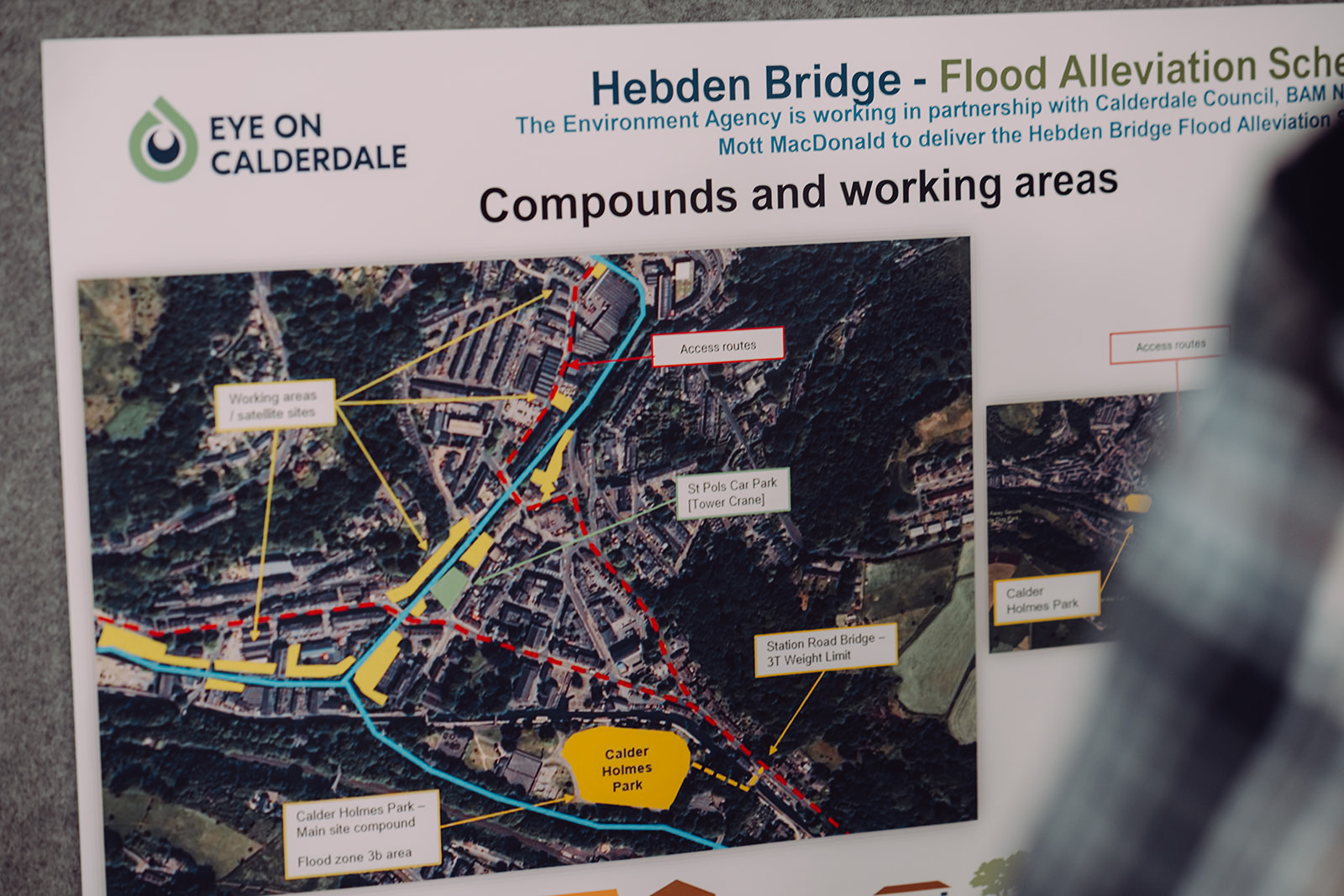
Hebden Bridge Flood Alleviation Scheme information board displaying a detailed map. The map outlines the local area, highlighting key flood risk zones, river paths, and planned or existing flood defences. Labels and colour-coded sections provide clear visual guidance for residents and visitors about the scheme’s scope and impact.

Public consultations

The Environment Agency is committed to working closely with the Hebden Bridge community. We regularly meet with partners, local councillors, and community representatives to share progress and gather feedback.

We have established a dedicated Key Stakeholder Group to ensure local voices are heard.

We actively participate in local forums to refine our proposals based on specialist feedback, including:

  • Hebden Bridge Business Forum

  • Disability Access Forum

As details of the design of the scheme develop there will be further consultations with people who are affected to discuss proposals. 

The first consultation event with the local community was held in June 2017.

A report which includes all the public feedback is available here. This report highlighted the issues we need to consider when developing the proposals for the scheme. Historic England and Calderdale planning officers have been consulted to ensure the scheme is sympathetic with the character of the town and heritage.

An initial public consultation was also carried out in 2018 on the Stubbing Holme Road proposals and feedback has been considered for the design.

Contact the project team by email: [email protected]

Back to the Top
arrow arrow
Website Feedback Your Opinion Matters Thank you for submitting your feedback
arrow

Have you found what you were looking for on our site today?

Yes, thank you
No, unfortunately not
I’m not sure, I’m still looking

Would you be willing to share a bit more detail about your site experience today? It will only take a few minutes of your time.

Yes please
No thank you

This will help us to make future improvements to our website to help you find the information that you need quickly and efficiently.

Skip to content